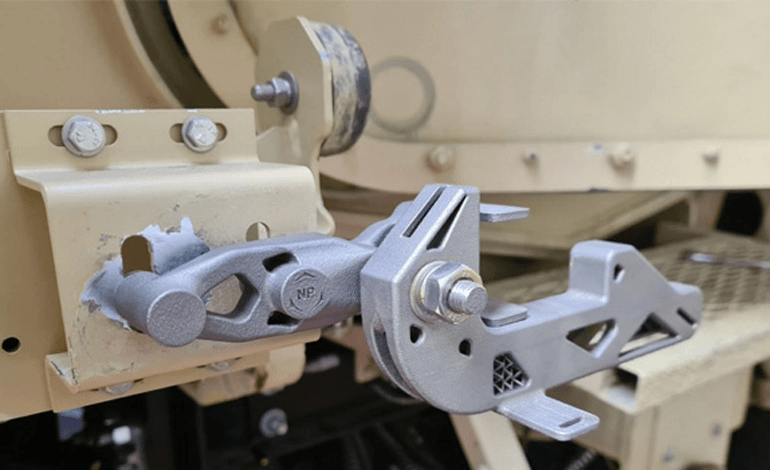
The UK Ministry of Defence has published its first Defence Advanced Manufacturing Strategy, which identifies Additive Manufacturing as crucial to the British military’s strategic roadmap and highlights AM’s role in strengthening supply chain resilience.
The document stresses the urgent need to accelerate Additive Manufacturing adoption across the UK’s defence sector. The MOD has outlined three core initiatives to accomplish this goal: investing to incentivise industry, adapting policies to remove barriers, and integrating Additive Manufacturing into the defence supply chain.
The key benefits of Additive Manufacturing for defence applications include faster production, reduced lead times, access to obsolete parts, and improved sustainability. The Defence Science and Technology Laboratory (Dstl) identified obsolescence as the primary supply chain challenge affecting military operations in 2021, impacting both legacy and modern platforms. With an inventory exceeding 1.3 million items, the MOD views Additive Manufacturing as a viable solution for producing many obsolete components.
The UK defence leadership believes Additive Manufacturing will significantly improve platform and equipment availability. According to a Defence Innovation Unit (DIU)-commissioned report, producing just 15% of the defence inventory using Additive Manufacturing could yield £110M in savings over the next 15 years, with potential annual net benefits of £35.5M thereafter. According to the new defence strategy, Additive Manufacturing represents the “first step” toward the MOD’s broader adoption of other advanced manufacturing technologies.
Vice Admiral Andy Kyte, Chief of Defence Logistics and Support, shared, “This strategy outlines our intent to embrace AM in new designs, to help resolve obsolescence and to increase our competitive edge through development of expeditious battle damage repair techniques.”
“This exciting technology has been in existence for some time, and defence must now realise the latent benefits it offers, in terms of operational availability, improved supply chain resilience and efficiency,” Kyte continued.
Introducing the MOD’s Defence Advanced Manufacturing Strategy
Conflicts in Ukraine and the Middle East have worsened supply shortages, limiting access to essential products and raw materials. These global challenges have increased the need for more resilient supply chains. Additionally, reductions in Armed Forces and Civil Service personnel, combined with smaller fleets and ageing equipment, have reduced availability, productivity, and efficiency.
The MOD is adopting Additive Manufacturing to tackle these challenges through its new Advanced Manufacturing initiative. The strategy demonstrates how Additive Manufacturing enables the creation of decentralised networks of qualified suppliers with the aim of reducing lead times, addressing obsolescence issues, and enhancing sustainability. The MOD’s Additive Manufacturing vision rests on four key pillars: design sources, digital thread, certification, and mobile production capabilities that enable parts fabrication near the point of need.
Design sources create additively manufactured parts through two methods: designing new components specifically for Additive Manufacturing (DfAM) or reverse engineering existing parts. The digital thread securely transmits sensitive design information from a design library to the Additive Manufacturing machine, while enabling users and manufacturers to send design change requests back to designers. Ensuring cybersecurity and information consistency is crucial. The MOD is exploring the development of a unified, fully integrated digital service to connect with design libraries. The finalised design is certified before being deemed fit for military operations and additively manufactured, sometimes near the frontlines.
These stages will operate within a circular economy that leverages the recyclability and reusability of Additive Manufacturing materials. The British military is currently developing methods to recycle high-end scrap metal into new metal Additive Manufacturing feedstock. For example, British engine manufacturer Rolls-Royce recently partnered with the MOD to convert old Tornado fighter jet components into new additively manufactured jet engines. This initiative, called Tornado 2 Tempest, has successfully produced components for the Orpheus jet engine concept, supporting the Future Combat Air System (FCAS) programme.

Author: Andy Cormack