As part of the international research project Ad-Proc-Add II (Advanced Processing of Additively Manufactured Parts II), the Institute of Production Engineering and Photonic Technologies (IFT) at TU Wien, Vienna, Austria, is contributing to the advancement of hybrid manufacturing processes. In close collaboration with partner institutions from Austria, Germany, and Belgium, IFT has developed innovative approaches for combining additive and subtractive methods along the entire process chain.
The project, funded by the Austrian Research Promotion Agency (FFG), the German Federal Ministry for Economic Affairs and Climate Action (BMWK), and for Flanders Agency for Innovation & Entrepreneurship (VLAIO), was coordinated by the ecoplus Mechatronics Cluster, FKM, and KU Leuven. Its goal was to enhance the cost-efficiency and precision of manufacturing highly complex components. In this context, IFT played a key role in developing innovative, application-ready technological solutions using simulation-based process models, which are expected to make future industrial applications significantly more efficient and sustainable.
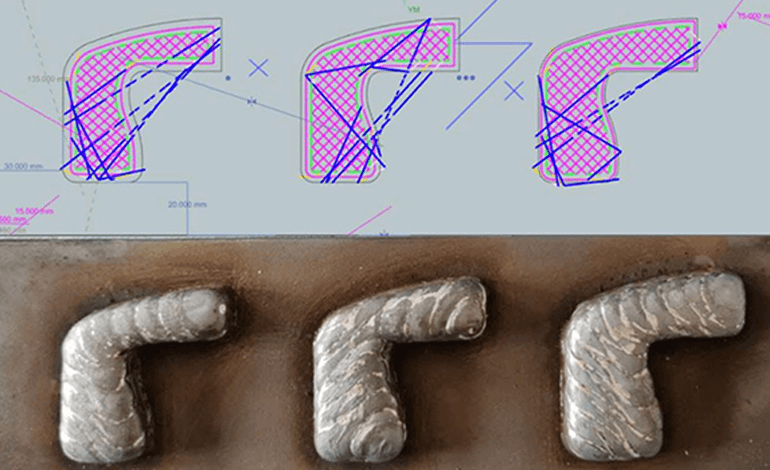
One of IFT’s research priorities was analysing the resulting material structure and surface integrity along the Additive-Subtractive Manufacturing (ASM) process chain. In the area of Directed Energy Deposition (DED), researchers in Vienna examined, among other factors, the influence of various process parameters and post-processing methods on surface and substructure properties. The findings provide crucial insights for the targeted adjustment of component characteristics such as hardness, residual stresses, and surface roughness.
Machine Hammer Peening, an intermediate treatment method tested by IFT, demonstrated significant improvements in the densification and homogenisation of the surfaces of additively manufactured components. When combined with methods such as shot peening and Hirtisation, post-processing could be systematically optimised.
A key contribution from IFT was the development of a simulation model to predict the topography, stress distribution, and deformation of additively manufactured components even before the actual production process begins. Using the Finite Element Method (FEM), a foundation was established for predictive process planning.
In a further step, the simulation was extended to include an analysis of machinability, with the aim of optimising machining strategies in advance based on the AM data. This enables precise definition of the minimum necessary machining allowances, significantly reducing material consumption and post-processing time.

Author: Andy Cormack