Project: 101177704
HORIZON-CL4-2024-RESILIENCE-01-11
Responsible Extraction and Processing of Titanium and other Primary Raw Materials for Sourcing EU Industrial Value Chains and Strategic Sectors
The REPTiS project aims to provide a sustainable and energy-efficient solution for the responsible extraction and processing of titanium and other critical raw materials. Collaborating with strategic partners, including those in Ukraine, REPTiS seeks to strengthen the EU’s industrial supply chains with a zero-waste approach.
REPTiS develops innovative technologies to reduce carbon footprint and enhance industrial viability and environmental safety. The patented Velta Ti process produces titanium alloy powders with low oxygen content and valorizes numerous by-products.
The project includes case studies in the medical, aerospace, and consumer goods sectors to demonstrate the performance of new technologies and their environmental impact. REPTiS is committed to developing a circular economic model and an exploitation plan to achieve the EU’s climate neutrality goals.
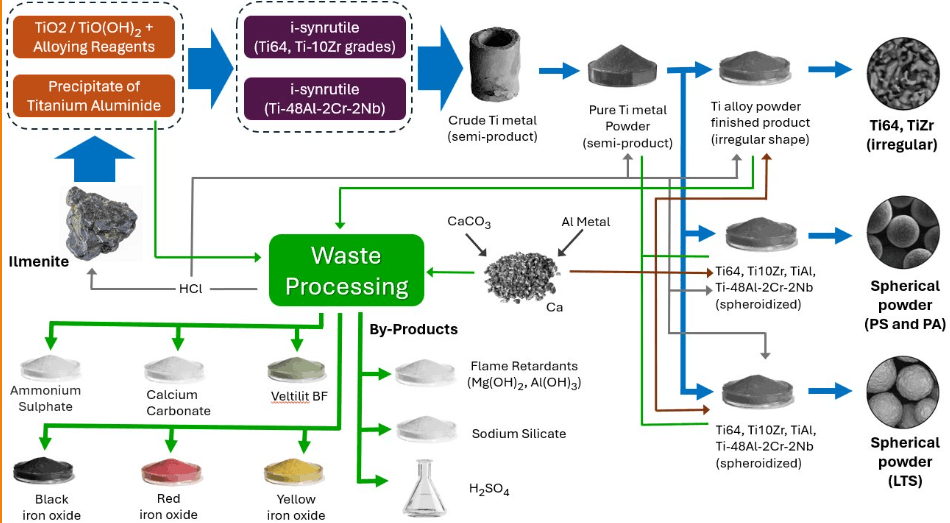
Case studies will be utilized to showcase the performance and capabilities of the new processes, demonstrating that the project technology achieves the targeted TRL7.
Four case studies have been selected from diverse sectors to comprehensively cover the titanium industry. These sectors include medical, aerospace, and consumer goods.
Functionality assessments will be conducted using relevant measurement and testing devices, along with in-house evaluation and application tests performed by associated industrial partners. Each of the four cases will be individually examined in detail regarding economic feasibility, CO2 footprint, energy, and water consumption through LCA and LCC studies.
A Product Environmental Footprint (PEF) report will be generated to document the environmental performance.
- 11 Participants from Industry & Academia
- Coordinator: EPMA
- Total Budget: 7.3 M€
- Duration: 4 Years

Funded by the European Union. Views and opinions expressed are however those of the author(s) only and do not necessarily reflect those of the European Union or HaDEA. Neither the European Union nor the granting authority can be held responsible for them.