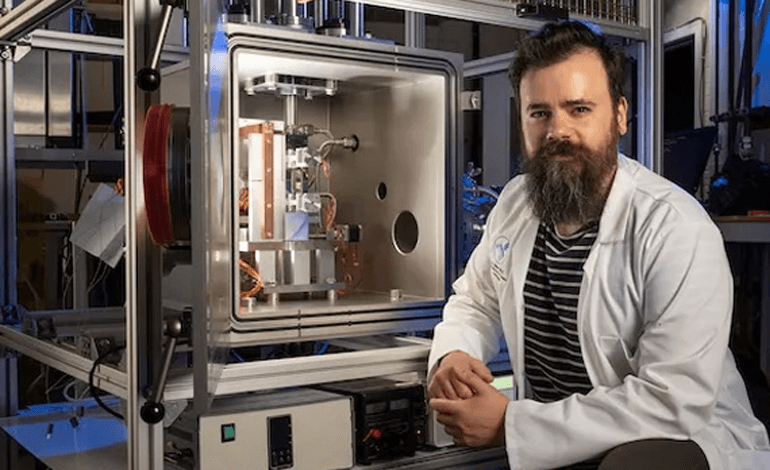
Researchers at the University of Glasgow’s James Watt School of Engineering have built the NextSpace TestRig, reportedly the world’s first dedicated facility for testing the structural integrity of materials that will be additively manufactured in space. The NextSpace TestRig was developed by the University’s Dr Gilles Bailet in partnership with The Manufacturing Technology Centre, supported by funding from the UK Space Agency (UKSA).
The facility, which uses a specially constructed vacuum chamber capable of generating temperatures between -150°C and +250°C to create space-like conditions on Earth, is designed to support the developing field of space manufacturing.
Space manufacturing aims to radically transform the way objects and materials are deployed into orbit. Instead of carrying complete devices like solar reflectors into space on rockets, specially designed Additive Manufacturing machines could create structures more cheaply directly in orbit. Several experiments have already sent prototype AM machines into orbit, and metal parts have been additively manufactured by astronauts aboard the International Space Station.
Until now, no research facility has, reportedly, been dedicated to ensuring that polymers, ceramics and metals printed in orbit will be able to withstand the extreme physical strains they will face in space.
Objects in space are subjected to a hard vacuum that cycles rapidly between extremes of temperature, conditions that can negatively impact the structure of additively manufactured materials that aren’t rigorously constructed. Imperfections, such as tiny bubbles or poorly melted sections, might be inconsequential on Earth but can behave very differently in space.
Those flaws could cause additively manufactured objects to shatter, scattering dangerous fragments into orbit which would contribute to the growing problem of ‘space junk’ – pieces of debris from defunct satellites, previous space missions, or collisions between human-made objects in orbit.
Dr Bailet shared, “3D printing is a very promising technology for allowing us to build very complex structures directly in orbit instead of taking them into space on rockets. It could enable us to create a wide variety of devices, from lightweight communications antennas to solar reflectors to structural parts of spacecraft or even human habitats for missions to the Moon and beyond.”
“However, the potential also comes with significant risk, which will be magnified if efforts to start 3D printing in space are rushed out instead of being properly tested. Objects move very fast in orbit, and if a piece of a poorly-made structure breaks off it will end up circling the Earth with the velocity of a rifle bullet. If it hits another object like a satellite or a spacecraft, it could cause catastrophic damage, as well as increase the potential of cascading problems as debris from any collisions cause further damage to other objects,” Dr Bailet added. “The NextSpace TestRig is open to academic colleagues, researchers and commercial clients from around the world to help them ensure that any materials they plan to 3D print in space will work safely. We also expect that the data we’ll be gathering in the years to come, which can’t be replicated anywhere else in the world at the moment, will help regulatory authorities to make safety standards for in-space manufacturing, informed by real-world testing.”
The testing facility features a unique magazine machine that can autonomously test multiple samples in a single cycle, making it significantly more efficient than traditional testing methods. The machine can apply up to 20 kilonewtons of force (equivalent to 2,000 kilograms) to break samples and analyse their properties in vacuum conditions matching those of space. It can also subject samples to cycles of extreme temperatures, replicating those they would face in orbit.
The facility is the latest development in Dr Bailet’s research in spaceborne Additive Manufacturing. He has also patented a prototype AM machine, which is designed for use in orbit and has been tested during a series of trips on a research aeroplane.

Author: Andy Cormack