Urwahn Engineering GmbH, Magdeburg, and wheelset and component manufacturer Roland, based in Garrel, have announced the Smart Bike Factory Made in Germany initiative. This will focus on the creation of regional value through the use of additively manufactured frame platforms, highly automated wheel production, and digitised processes.
The companies are utilising Urwahn’s additively manufactured frame platforms to match wheelsets and bicycles to one another in terms of performance, weight and safety. This cooperation extends from design and engineering through testing procedures, to shared standards in quality assurance and traceability.
“Urwahn challenges us in the best possible way. We work in short cycles, with high variance and a clear focus on quality,” stated Heiko Plorin, Managing Director of Roland. “That forces us to rethink processes, reduce set-up times, further develop our automation and remain flexible at the same time. This is precisely what makes the partnership so valuable – it pushes both of us forward technologically.”
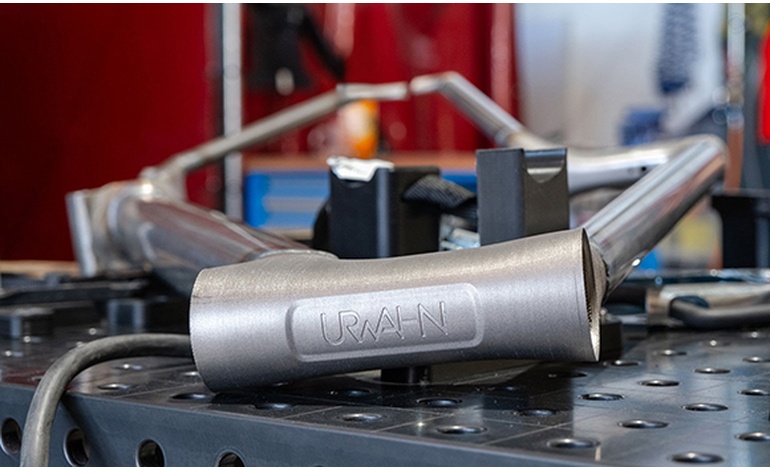
Last year, Urwahn partnered with Trumpf (now Atlix) to develop its SOFTRIDE steel bike frames which are produced using Laser Beam Powder Bed Fusion (PBF-LB) Additive Manufacturing. Trumpf provided the machinery and material parameters, while H+E Produktentwicklung GmbH established the entire process for serial production and contributed feedback to optimise the frame design. The company also introduced a limited edition version of the SOFTRIDE featuring an additively manufactured titanium alloy frame in January 2026.
The adoption of Additive Manufacturing enables a reduction in post-processing steps such as welding or extensive mechanical machining, leading to a reportedly significant enhancement in manufacturing efficiency and overall improvement to Urwahn’s production process. PBF-LB enables the creation of internal cavities that would be difficult to produce using traditional manufacturing methods, as well as precise control over layer construction, allowing the final product to have fine-tuned mechanical properties.
“We are no longer talking about a conventional supplier set-up, but about an integrated part of our value chain,” explained Leonard Harress, COO of Urwahn. “For us, Roland is both a local hero and a technology partner. Together, we no longer think of wheelsets as mere components, but as an integral part of a smart bike factory, where quality, automation, digitalisation and flexibility come together.”
In a video about the collaboration, Harress, stated, “When we talk about a smart bike factory, we are not just referring to our own site in Magdeburg, but to the entire network of partners operating at the same level of quality and technological sophistication. Roland is very much part of that for us.”
With ongoing market consolidation reported in the bicycle sector, Urwahn and Roland also consider their cooperation an ‘alternative to short-term thinking’ in the sector: rather than shifting costs elsewhere, the focus is on strengthening local value creation, clean processes, the highest safety standards and a form of production that enables both scaling and individualisation.
“Resilience in times of crisis does not emerge from gut feeling, but from robust structures and reliable partnerships,” Harress added. “Roland is one of those partners with whom we not only master current challenges, but also shape the next stage of industrialisation in the bike segment.”
“At the same time, the message to the market is clear: the shared infrastructure – consisting of 3D printing, engineering expertise, automated wheel building and digitalised workflows – is not a closed system behind locked doors. It is intended as an open platform for further collaborations with companies that want to rethink mobility, technology and production.”

Author: Andy Cormack